
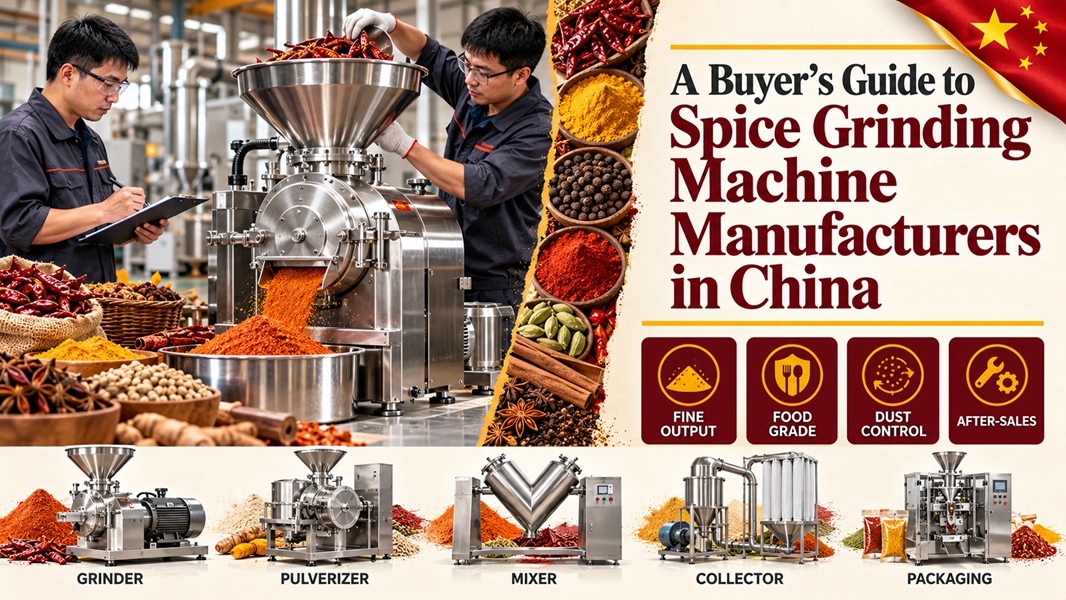
A Buyer’s Guide to Spice Grinding Machine Manufacturers in China
Spice grinding equipment must deliver the required particle size without damaging aroma, overheating the product or creating difficult cleaning work. A grinder that performs well on dry pepper may behave differently with oily seeds or fibrous roots. Buyers evaluating spice grinding machine manufacturers in China should therefore start with material samples and finished-product targets. The best supplier can explain the grinding principle, demonstrate it on the hardest product in your range and show how the machine will be cleaned and maintained.
Describe every spice and the required result
List whole or pre-cut ingredients, their moisture range, oil content, starting size and desired output. Decide whether the final specification is a sieve pass percentage, a distribution of particle sizes, or a texture suitable for a particular recipe. State the temperature limit if flavor or color is sensitive to heat. Include allergens or strongly colored ingredients that could complicate changeovers. If you will grind several products, name the one most likely to clog screens and the one most likely to carry over into the next batch. A single generic “spice powder” specification hides important differences.
Compare grinding methods through trials
Depending on the spice and fineness target, a manufacturer may recommend a hammer mill, pin mill, pulverizer or staged system. Ask why the method fits your material and what screen or rotor changes are required. Request a test with your sample and collect data on feed rate, finished particle size, product temperature, power draw and yield. Examine the powder for discoloration and aroma loss, then have your own quality team test it. Ask how the machine behaves after an extended run, not just a few minutes. A successful trial should reproduce the specified product at a commercially useful throughput.
Control heat and dust
Grinding turns some motor energy into heat. Ask where temperature is measured and what options exist for airflow, pre-cooling or staged grinding when the product is sensitive. Fine spice dust can escape through poor seals and make cleaning difficult; some dusts can also present fire or explosion hazards. Require the manufacturer to identify dust collection points, filtration requirements, grounding and the protection measures suitable for the material and jurisdiction. Do not treat a dust collector as a complete safety design. Have a competent local specialist review the installed system, including ducts and housekeeping procedures.
Examine food-contact surfaces and access
Request drawings or photos showing the feed hopper, chamber, discharge, screens, seals and places where powder may accumulate. Ask which parts touch food and what they are made from. The design should let operators inspect and clean those surfaces at the frequency your product changes require. If the machine uses screens or liners, confirm how quickly they can be removed and reinstalled without misalignment. Review access around bearings, lubricant points and motors so maintenance does not contaminate food areas. Have the supplier demonstrate a full changeover and record the time as part of the factory test.
Plan ingredient handling around the mill
The grinder is only one step between raw spice intake and finished powder. Decide how material will be inspected, cleaned, metered into the hopper, screened after grinding and packed without picking up moisture. Ask whether a magnet, separator, feeder or transfer system is included in the offer, and where each component should sit. Estimate the storage needed for whole spices and finished powder so operators do not leave open containers next to the mill. A clear material flow makes contamination control easier and prevents an expensive grinder from sitting idle while staff hand-feed or manually move product.
Put safety into the purchase specification
Rotors and drive components need guarding and safe access for clearing blockages. Ask for interlocks where doors open onto hazardous motion, an accessible stop, clear isolation instructions and a procedure for removing jammed material. Verify noise and vibration during the product trial. The machine should not require operators to defeat a guard to inspect powder or change a screen. Agree the safety requirements of the destination market before build and obtain documentation for the installed configuration. General safety badges or an unexplained certificate do not replace a review of the actual machine.
Measure total output, not brochure capacity
Quoted kilograms per hour may refer to an easy test ingredient at a coarse grind. Define acceptance output as kilograms of in-spec powder per hour after screening and normal stoppages. Include any pre-cutting, cooling, regrinding and cleaning time in the process plan. Ask for utility consumption at your target throughput, plus filter and screen replacement intervals. A lower priced mill with frequent screen changes can cost more per kilogram than a slower-looking machine that stays in specification for a full shift.
Protect future serviceability
Obtain a list of wear parts such as hammers, pins, screens, liners, bearings and seals, with prices and expected replacement triggers. Confirm motor, bearing and control components available in your market. Request manuals, exploded views and a baseline set of operating readings so maintenance staff can recognize a problem early. For export, agree crate protection, moisture control and how the rotor will be secured during transport. EquipMachines describes spice grinders and pulverizers within its food milling range. Use your trial results and cleaning needs to compare that range, and any competing manufacturer, on evidence rather than catalogue labels.
Spice processors and ingredient suppliers in Egypt, Morocco, Algeria, Tanzania, South Africa, Guyana, Paraguay, Chile, Argentina, and Bolivia should test Chinese grinding machines with the spices they intend to sell. Provide the raw material’s moisture range, target particle size, expected output, and cleaning needs between products. Ask the supplier to measure finished powder yield, product temperature, and throughput during a sustained trial. Compare access to screens and wear parts, dust handling, and maintenance support before choosing a machine for commercial production.
Spice Grinding Machine Manufacturers in China
- Why should I test my own spices in a grinder? Spices differ in moisture, oil content, and texture, which can change throughput, clogging, and final particle size.
- How do I compare grinding capacity fairly? Measure kilograms of powder meeting your specification per hour using the same ingredient and grind size.
- What should I check for product quality? Examine particle size, color, aroma, product temperature, and carryover after cleaning.
- What safety features matter in a spice mill? Review guards, safe access for clearing jams, dust collection, electrical isolation, and controls appropriate to the material.