
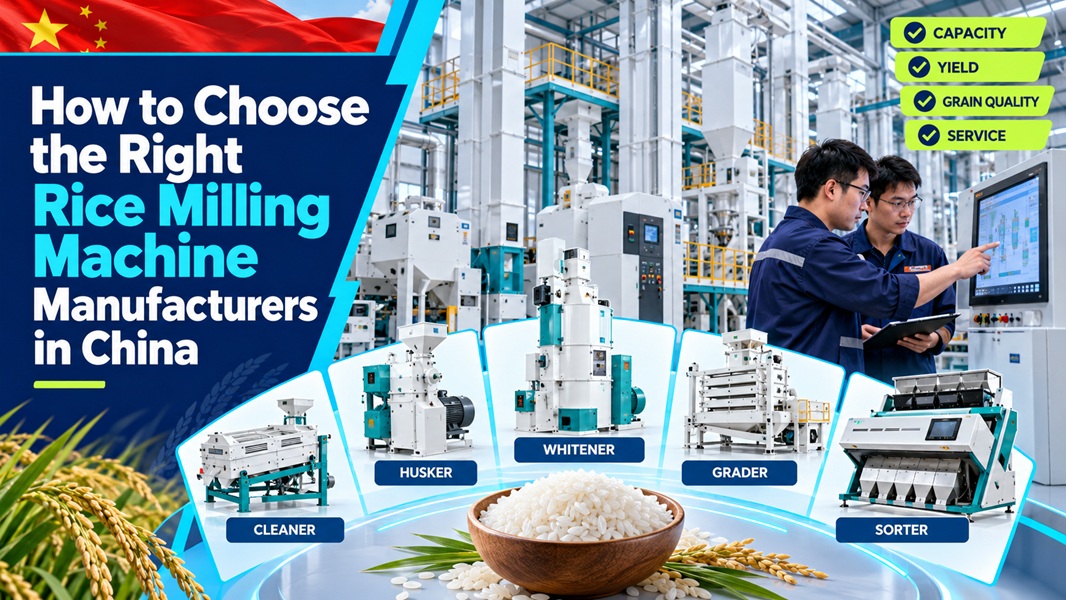
How to Choose the Right Rice Milling Machine Manufacturers in China
Rice milling is a chain of processes, not one universal machine. A small huller for village service work and a complete commercial line have different layouts, yields and operating costs. When evaluating rice milling machine manufacturers in China, the buyer should describe the incoming paddy, the desired white rice and the value of the by-products. The strongest proposal will show a balanced process, measurable recovery and service support that fits the local workforce.
Start with the paddy and the market
Record paddy variety, moisture range, impurity level, expected input tonnes per shift and seasonal operating pattern. Describe the desired grade, degree of whiteness, percentage of broken rice accepted and whether polished rice is required. If the business sells bran, husk or graded broken rice, include the by-product handling plan. Do not compare recovery figures from different paddy quality or moisture conditions as if they were machine-only results. Agree how input and output will be sampled and weighed before a trial.
Understand the required process stages
A typical line may involve cleaning, destoning, husking, paddy separation, whitening, polishing, grading and packing. The exact sequence and equipment depend on the product and budget. Ask the manufacturer to provide a flow diagram showing capacity at each stage, transfer method and expected losses. A fast husker will not improve sales if the separator or grader becomes a bottleneck. Check whether a quoted package includes elevators, conveyors, dust control, bins and controls. These often determine whether equipment can be installed and operated as promised.
Match automation to the operator team
Ask who will run the mill, how much training they have and which adjustments they must make during a shift. Basic controls may be sufficient where paddy is uniform and skilled operators are available. More automation can help stabilize flow, but it also adds sensors, controls and troubleshooting needs. Have the supplier show the operator screen or panel, alarm messages and manual override procedure. Request training on how a change in feed moisture or impurity affects settings. A line that local staff can understand and maintain is more valuable than a sophisticated specification that depends on unavailable specialist visits.
Ask for a transparent performance test
Define the trial by paddy type, moisture, impurity level, run length and operator settings. Measure tonnes of input, finished rice, broken rice, bran and husk. Record electricity use, stoppages and adjustments. Request samples so your team can judge appearance and grading. Ask for the results at the whiteness you intend to sell, because aggressive whitening can change recovery and breakage. If you cannot attend the test, arrange independent sampling and a continuous video record. A useful acceptance clause makes the trial repeatable after installation.
Examine durability and adjustment
Review the material and access of hulling rollers, whitening chambers, screens, bearings and belts. Ask how quickly operators can change wear parts and how settings are indicated. A simple, well documented adjustment can be more valuable than a complex control system that local technicians cannot support. For abrasive or dirty paddy, seek evidence that the proposed cleaning stage protects downstream parts. Ask how dust is extracted and where it is discharged. Check guarding around belts, elevators and rotating parts, and confirm access for safe maintenance.
Size the site and utilities
Provide available floor area, ceiling height, structural limits, electrical supply and expected storage volumes. Ask for a scaled layout showing operator paths, service access, incoming paddy, finished rice and by-product movement. Confirm total connected load and expected demand under working conditions. If the site has unstable power, discuss startup sequencing and protection. If the mill is intended for remote locations, compare electric and engine-driven options using local fuel and maintenance conditions. Include foundations, ducting and installation materials in the project budget.
Compare economic yield and cost
Purchase price is only one part of the calculation. Estimate saleable rice per tonne of paddy, broken rice value, energy, labor, consumables, maintenance and downtime. Ask for realistic wear part prices and delivery times. Use the same paddy assumptions for every supplier proposal. Avoid accepting a single high “milling recovery” number without its test conditions and definition. A modest improvement in whole grain recovery may matter more than a small saving on the machine, but only if the result is repeatable with your local varieties and staff.
Agree what happens after commissioning
Set a time window for a supervised production run with local paddy after installation. Define who supplies raw material, labor and utilities, and what happens if the promised output or recovery is missed. Ask the manufacturer to leave a written record of machine settings, measured results and maintenance tasks. Schedule a follow-up after operators have used the line for several weeks so early issues can be corrected. This step prevents acceptance from being reduced to a simple power-on check and gives both sides a shared baseline for future service calls.
Verify supplier delivery capability
Clarify which machines are made by the supplier and which are integrated from partners. Name the party responsible for the entire line, commissioning and performance remedy. Request references for similar capacity and paddy, plus manuals, electrical drawings and a parts list. Agree factory and site acceptance tests, training days and a starter parts package. For imports, check crate sizes, shipping terms, documentation and customs classification with your logistics team. EquipMachines lists hullers, whiteners, polishers and complete rice milling plants. A request that includes paddy data and the target rice grade will produce a more meaningful proposal from it or any other manufacturer.
Rice millers, cooperatives, and project buyers in Nigeria, Ghana, Tanzania, Angola, Egypt, Colombia, Peru, Venezuela, Ecuador, and Brazil should describe their paddy before requesting rice milling machinery from China. Share the variety, moisture range, impurity level, input per shift, and grade of finished rice required. Ask manufacturers to show the proposed process from cleaning through grading and to test recovery and broken-rice levels with representative paddy. Include elevators, dust control, operator training, and spare parts when comparing complete line quotations.
Rice Milling Machine Manufacturers in China FAQ
- What paddy information does a manufacturer need? Provide variety, moisture range, impurity level, and the quantity to be processed per shift.
- What does a complete rice milling line include? It may include cleaning, destoning, husking, separation, whitening, polishing, grading, and packing equipment.
- How should I assess milling recovery? Use a documented trial with measured paddy input and separate weights for finished rice, broken rice, bran, and husk.
- Why does the site layout matter? The line needs suitable space for material flow, operators, dust control, maintenance access, and by-product handling.