
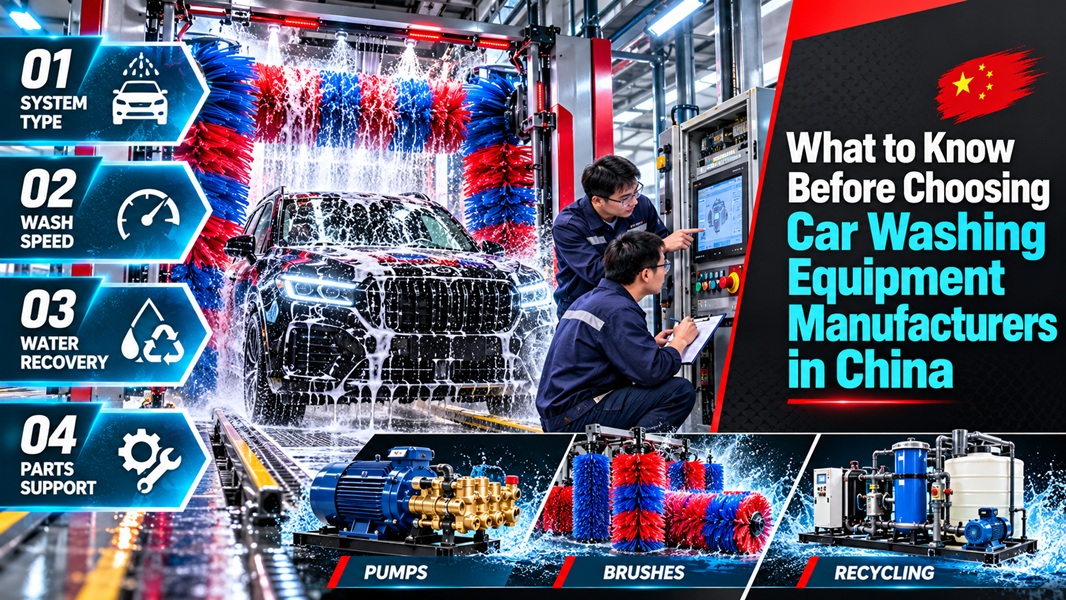
What to Know Before Choosing Car Washing Equipment Manufacturers in China
Car washing equipment ranges from a single pressure washer to a fully automated vehicle wash. The best choice depends on the vehicles, site, water supply, local operating costs and service model. Buyers evaluating car washing equipment manufacturers in China should plan the complete wash process before comparing machines. An automatic system with an impressive headline capacity may underperform if the site cannot provide water, drainage, access or maintenance support.
Define the vehicles and service promise
List passenger cars, SUVs, buses or trucks separately, with maximum length, width and height. State the expected vehicles per hour and per day, peak arrival pattern and target wash time. Decide whether the business will provide exterior wash only, underbody cleaning, interior vacuuming, detailing or polishing. These choices affect pressure washers, brushes, chemical dosing, drying and staff needs. A fleet depot may value durable throughput, while a premium retail wash may value finish quality and flexible programs. Ask the manufacturer to design around the actual service mix.
Compare technologies on outcomes
Manual bays, rollover systems and conveyor washes offer different trade-offs in floor space, staffing and capacity. Request a layout and process sequence for each proposal. Ask how pre-soak, washing, rinsing, drying and chemical application are controlled. For pressure washers, compare both pressure and water flow at the nozzle; either figure alone is incomplete. For brush systems, ask how contact force and cleaning media are managed for different vehicle shapes. Run a demonstration on dirty vehicles typical of your area and inspect difficult spots, wheels and lower panels afterward.
Calculate water and chemical demand
Ask for measured water use per vehicle under the proposed wash programs, not only a minimum figure from an ideal cycle. Confirm source-water quality, pump requirements, filtration and any recycling system. Reuse water may be appropriate for some stages but needs treatment and monitoring; specify where fresh water is required. Review detergent and wax compatibility, dosing accuracy and chemical storage. Check local discharge rules, sediment removal and oil separation requirements with the relevant authority or site engineer. Wastewater planning is part of the wash design, not an accessory to decide after the machine arrives.
Inspect site fit and utilities
Provide a site drawing showing entry and exit paths, queue space, bay width, ceiling height, foundation, drainage and vehicle turning radius. Confirm electrical load, voltage, frequency, air supply, water pressure and expected winter temperatures. Request civil and utility drawings early so installation costs can be estimated. An automatic wash can require barriers, traffic controls and safe pedestrian separation. Make sure service technicians can reach pumps, filters and control cabinets without blocking the entire site. A compact machine with poor access may create long shutdowns.
Focus on reliability and operator safety
Review corrosion protection, pump and motor ratings, hose quality, seals, sensors and control cabinet protection. Ask how the system detects a vehicle in the wrong position and how emergency stops work. Moving frames, high-pressure jets and electrical equipment near water need careful installation and clear operating procedures. Define daily checks and planned maintenance, including filters, nozzles, brushes and water treatment. Ask for fault logs and remote diagnostic options where available. A manufacturer should explain common failures and the parts stocked to fix them.
Test the economics under local conditions
Calculate contribution per wash using expected selling price, labor, water, chemicals, electricity, wastewater handling and maintenance. Use realistic daily volume rather than the machine's theoretical maximum. Include weather variation and peak queuing; lost customers during busy hours may matter more than a small difference in energy use. Compare the cost of manual, semi-automatic and automatic designs against the service quality each can deliver. For fleet users, estimate labor hours saved and vehicle availability. Request a clear list of consumables and annual replacement costs from each supplier.
Check customer flow and staff tasks
An equipment plan should show what drivers and workers do before, during and after a wash. Mark payment or check-in points, the safe waiting area, vehicle guidance, manual pre-treatment and interior cleaning space. If cars queue onto a public road, the site may need a different capacity or entry layout. Ask the manufacturer to identify tasks that still require staff even in an automatic system, such as chemical refilling, filter cleaning and handling unusual vehicles. A realistic staffing plan helps avoid both unsafe shortcuts and inflated labor savings in the business case.
Protect finish and customer trust
Agree how the wash will handle mirrors, roof accessories and nonstandard vehicles. Post clear limits for vehicle height and accessories at the entrance. During the acceptance trial, inspect for missed dirt and any damage to paint, trim or seals, then record how a complaint will be investigated. A manufacturer should explain routine brush or nozzle checks that help preserve finish quality. For a retail site, consistent results and a clear operator response to exceptions are as important as a fast cycle.
Set acceptance and support terms
Specify a factory inspection, site commissioning, test vehicles, acceptable wash quality, cycle time and utility consumption. Agree who supplies installation, training and local service. Obtain manuals, wiring and plumbing diagrams, software backup and a spare parts list. Check shipping dimensions and what arrives preassembled. EquipMachines describes a range covering pressure washers, automatic systems, vacuums and detailing equipment. Send a complete site and vehicle brief when requesting a quote; the right manufacturer should respond with a workable system plan and a testable service commitment.
Car wash operators, dealerships, and fleet managers in South Africa, Kenya, Ghana, Egypt, Morocco, Brazil, Chile, Argentina, Colombia, and Paraguay should plan the site before choosing vehicle washing equipment from China. Give suppliers the vehicles’ maximum dimensions, expected daily volume, bay layout, available water, and services offered. Compare wash quality and cycle time using representative vehicles, then calculate water, chemicals, electricity, labor, and maintenance per wash. Request installation drawings and a clear plan for training, spare parts, and local service.
Car Washing Equipment Manufacturers in China FAQ
- What should I define before requesting a car wash quote? Provide vehicle dimensions, expected daily volume, wash services, site drawings, and available utilities.
- Is higher pressure always better for vehicle washing? No. Water flow, nozzle choice, cleaning method, and suitable pressure all affect results.
- Should I consider water recycling? Assess local water costs, discharge requirements, treatment needs, and which wash stages can use recycled water.
- How do I test an automatic wash before acceptance? Wash representative dirty vehicles and check cleaning quality, cycle time, utility use, and safe vehicle handling.