
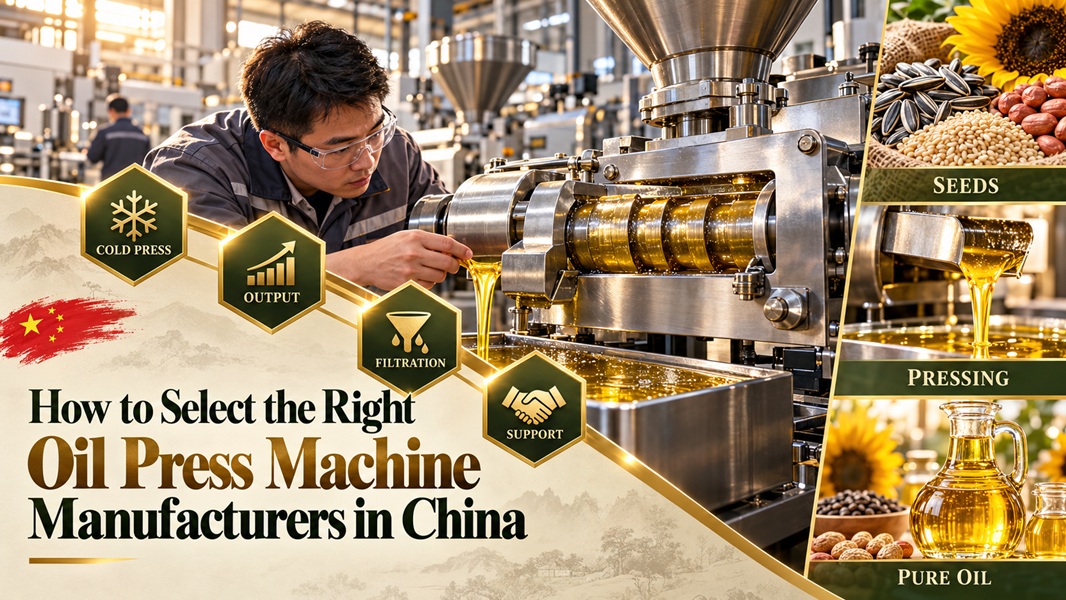
How to Select the Right Oil Press Machine Manufacturers in China
An oil press should be chosen for the seed, the intended oil quality and the economics of the whole process. A machine that performs well with one oilseed may give poor throughput or high residual oil with another. Buyers comparing oil press machine manufacturers in China need to distinguish pressing from preparation, filtration and refining, then ask for a trial based on their raw material. A precise specification makes supplier claims about yield and capacity easier to verify.
Identify the seed and product goal
State the crop, variety, moisture, expected impurity level and incoming seed size. Explain whether the business wants a cold-pressed specialty oil, crude oil for further refining, or another defined product. Specify acceptable oil temperature, appearance and quality criteria, along with the desired form and use of the press cake. Some seeds benefit from cleaning, dehulling, cracking, conditioning or heating before pressing. Ask the manufacturer which preparation steps its quoted yield assumes. A press-only quotation may omit essential equipment needed to reach the stated result.
Compare yield with a mass balance
Do not rely on a vague “high extraction” claim. For a trial, weigh seed input, crude oil, cake and any measurable loss. Have the cake tested for residual oil and the product checked against your quality criteria. Record seed moisture and preparation conditions, run duration, temperature and power use. Compare suppliers using the same material and target oil quality. A machine can increase apparent extraction by applying more heat or pressure, but that may be unsuitable for a premium oil. Ask for results over a sustained run to reveal plugging, wear or output drift.
Inspect the press design and wear parts
Discuss screw or expeller geometry, press cage, adjustable restriction, feed arrangement and drive system. Ask what can be adjusted when moving between seeds and how settings are recorded for repeat production. Request material specifications for food-contact surfaces and a clear route for oil collection. Find out how screw flights, cage bars, bearings and seals are replaced, their expected service life under your crop, and their cost. Check whether the supplier stocks parts for the quoted model. A low machine price can be costly if a custom screw is unavailable during harvest season.
Plan cleaning, filtration and further processing
Oil leaving a press may contain fines and require settling or filtration. Define how it will be transferred, filtered, stored and packaged, and ask which stages are included in the offer. If refining is planned, specify that separately and request a complete process flow. Review access for cleaning the hopper, press chamber and oil channels, especially when changing crops or producing edible oil. Ask how lubricants are kept away from the product. Food-contact design should be assessed against the actual process and destination requirements, not inferred from a stainless steel cover or a general claim of “food grade.”
Confirm capacity under continuous operation
Press ratings may refer to seed input under favorable conditions, not litres of saleable oil. Define required seed kilograms per hour, operating hours per day and planned maintenance windows. Ask for actual input, crude oil output, cake rate and electricity or fuel use at the desired quality. Check motor sizing, cooling and how the machine behaves if feed rate changes. If harvesting creates a short peak season, size the line to the available working days and include redundancy where a stoppage would be especially costly. Do not oversize so far that the machine runs inefficiently most of the year.
Review operator safety and site needs
The press has rotating shafts, hot surfaces and sometimes heated conditioning equipment. Require suitable guarding, accessible stop controls and a safe method for clearing jams and isolating power before maintenance. Request a layout showing feed height, oil drains, cake discharge, service clearance, ventilation and floor loading. Confirm voltage, phase, frequency and any steam or heat source. If dust is generated in seed preparation, plan collection and housekeeping. Have local electrical and food-safety specialists review the installed plant before production.
Clarify product quality after pressing
Before ordering, decide which quality checks will release a batch of oil for sale or further refining. These may include appearance, moisture, sediment and other criteria set by the buyer's food quality team. Ask how the press and any filtration equipment limit foreign material and oxidation during transfer. Discuss storage tank design, cleaning and the time oil may wait before the next process step. The machine trial should collect samples using a defined method rather than a jar filled at a convenient moment. Comparing suppliers on both oil quantity and quality prevents a high-yield claim from obscuring a product that needs expensive rework.
Assess the manufacturer as a long-term partner
Ask where the machine is built, who supplies the drive and controls, and who accepts responsibility for commissioning. Request references that use the same seed at a similar scale, along with a manual, parts list and training plan. Agree a factory acceptance test using your seed if practical, or a documented trial with representative material. Confirm warranty limits, remote support and lead times for wear parts. Include freight, installation, filtration, spares and possible yield differences in the total-cost comparison. EquipMachines lists oil processing equipment, including a palm oil screw press; tell any supplier exactly which crop you process so it proposes the appropriate machine rather than a superficially similar press.
Oil processors in Nigeria, Ethiopia, Kenya, Morocco, Algeria, Guyana, Suriname, Paraguay, Bolivia, and Uruguay can narrow their search for Chinese oil press machines by identifying the exact seed and oil product first. Specify seed preparation, desired oil quality, daily input, and whether filtration or further processing is needed. Request a trial that measures seed input, oil output, press cake, temperature, and power use. Before ordering, confirm the availability and cost of screws, cage parts, bearings, and seals so the press can be maintained during production.
Oil Press Machine Manufacturers in China
- Can the same oil press handle different seeds? Some machines can be adjusted, but performance and required seed preparation may vary by crop.
- How can I verify an oil-yield claim? Run a trial that weighs seed input, crude oil, and press cake under recorded preparation and operating conditions.
- Is a press enough to produce finished edible oil? It depends on the intended product. Filtration, storage, or further processing may also be needed.
- Which parts are important for maintenance? Ask about screw flights, cage components, bearings, seals, and their prices and delivery times.