
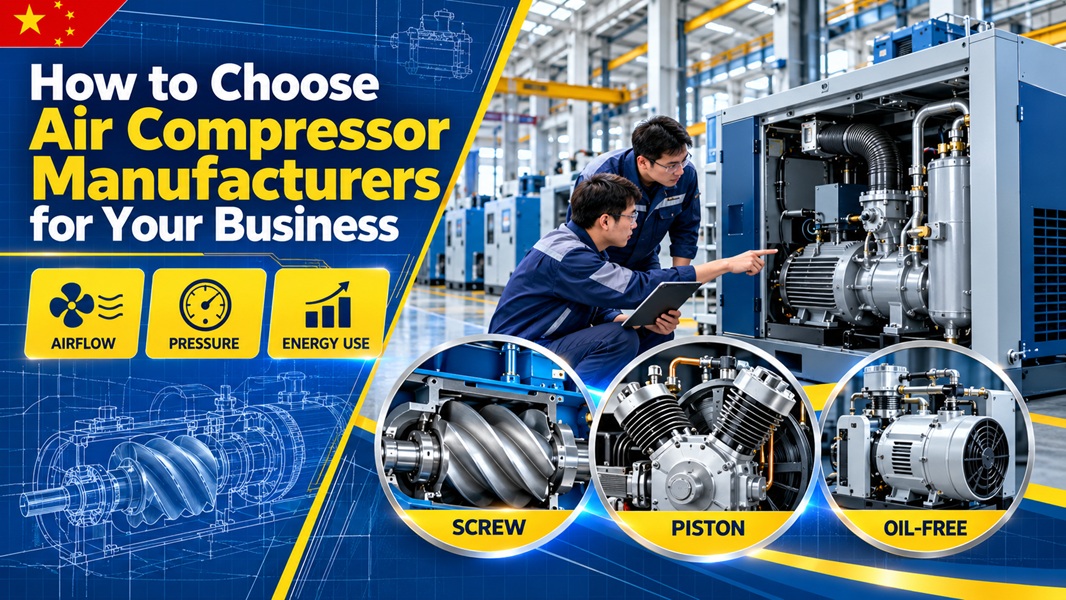
How to Choose Air Compressor Manufacturers for Your Business
Compressed air can run production tools, packaging equipment, controls and cleaning systems, but it is expensive to generate and easy to underspecify. Choosing an air compressor manufacturer begins with the air demand at each point of use, the pressure needed there and the required air quality. A larger nameplate motor is not automatically the better choice. The right supplier should size the complete system, explain operating cost and provide data that can be checked after installation.
Measure demand before requesting quotes
List each tool or machine, its required pressure and air consumption, and when it runs. Separate simultaneous demand from total installed demand. If possible, log pressure and flow over representative shifts, including peak production and cleaning. Identify future equipment that will be added, but avoid adding an arbitrary large margin to every line item. State whether air is needed continuously or in short bursts. A receiver can help manage brief peaks, while sustained demand requires adequate compressor output. Ask suppliers to show their sizing calculation and assumptions.
Compare delivered flow at the right pressure
Motor power and tank volume are not substitutes for delivered air flow. Request free air delivery or another clearly defined output measure at the proposed operating pressure, with test conditions stated. Pressure must be high enough at the end use after losses through dryers, filters and piping. Raising the compressor setpoint to compensate for undersized pipes wastes energy and may damage process control. Ask for a pressure drop estimate across the full system and check the proposed pipe layout. Compare competing quotations at the same pressure and flow basis.
Choose a technology for the duty cycle
Reciprocating, rotary screw and other compressor types suit different use patterns. Discuss starts per hour, continuous run time, part-load behavior, noise and maintenance skill available locally. For variable demand, ask how capacity control works and what efficiency is expected across the actual load profile, not only at full load. Consider whether multiple smaller units provide useful redundancy or better staging. A critical production line may need a backup compressor even when one large machine has enough rated capacity. Ask the supplier to model normal, peak and failure scenarios.
Specify air quality explicitly
Different processes tolerate different levels of particles, water and oil. Define the quality required at each point of use, then choose filtration, drying and monitoring to achieve it. A food-contact or instrument-air application may need much cleaner air than a workshop blow gun. Ask for the target purity class or measurable limits, the test method and the location where compliance will be verified. Compressor type alone does not guarantee the delivered air is clean; ambient intake, pipework and maintenance matter. Review the dryer dew point against local humidity and the lowest temperatures the piping may experience.
Review installation and energy cost
Request the electrical supply, starting current, heat rejection, ventilation requirement, noise level, dimensions and service clearances. A compressor room that overheats will undermine reliability. Plan condensate collection and disposal according to local rules, especially when oil may be present. Ask for a system energy estimate based on operating hours and load profile, plus service parts and labor over several years. A lower purchase price can be offset by high part-load power or frequent service. Compare lifecycle cost with the same electricity price and maintenance assumptions for each bid.
Verify controls, service and documentation
Ask what the controller records, how pressure bands are set and whether multiple compressors can be sequenced. Request electrical diagrams, a maintenance manual, recommended service intervals and a priced list of filters, belts, lubricants and separators. Clarify warranty exclusions and the response time for local support. If the compressor is imported, check availability of compatible service parts and trained technicians in your market. Have the supplier provide commissioning readings for pressure, temperature, current and delivered performance so future technicians have a baseline.
Check distribution losses and leaks
The air network deserves the same attention as the compressor. Ask the supplier to survey long pipe runs, restrictive connectors, undersized hoses and points where pressure falls during peak use. A leak test and a repair plan can sometimes free enough capacity to postpone a compressor purchase. Put isolation valves and measurement points where maintenance staff can find problems without stopping the whole plant. If several pressure levels are required, discuss regulation near each use rather than running every process at the highest pressure. Include a follow-up measurement after installation to confirm that the expected air reaches the farthest machine.
Decide how growth will be handled
Ask whether the proposed compressor room, controls and piping allow another machine to be added later. Reserve electrical capacity, ventilation space and connection points only where the expansion has a credible business case. If demand will grow in stages, a sequenced pair of compressors may be easier to expand and maintain than a single oversized unit. Request a drawing that distinguishes the current installation from future provisions, with costed options. This keeps growth planning visible without forcing today's operation to pay for unnecessary air production.
Make acceptance measurable
The purchase order should state delivered flow at pressure, air quality after treatment, allowable noise, utility conditions and the test method. Include a site test after piping and dryers are installed, because factory performance does not prove the full system works at the end use. Confirm shipping terms, documentation and responsibility for installation. EquipMachines includes air compressors in its automobile and garage equipment range. Whether your use is a workshop or a production plant, send a demand profile and air-quality target with the enquiry. A reliable manufacturer will return a complete system proposal that you can check against the process, not merely a compressor model number.
Workshop and industrial buyers in Nigeria, Angola, Algeria, Tanzania, Ethiopia, Peru, Bolivia, Uruguay, Venezuela, and Guyana should size a Chinese air compressor against measured demand at the point of use. List each machine’s required flow, pressure, operating schedule, and air-quality needs. Ask manufacturers to quote delivered flow at the specified pressure, including dryers, filters, receivers, and controls where needed. Compare energy use across the expected duty cycle, then confirm installation requirements, service intervals, parts availability, and an acceptance test for the complete air system.
Air Compressor Manufacturers for Business FAQ
- What information is needed to size an air compressor? List each air user’s required flow and pressure, then identify which users operate at the same time.
- Why is motor power alone a poor comparison? It does not show how much air reaches the process at the required pressure.
- Do I need a dryer and filters? That depends on the moisture, particle, and oil limits required at each point of use.
- How should I compare running costs? Use the same operating hours, demand profile, electricity price, maintenance schedule, and air-quality target for every quote.