
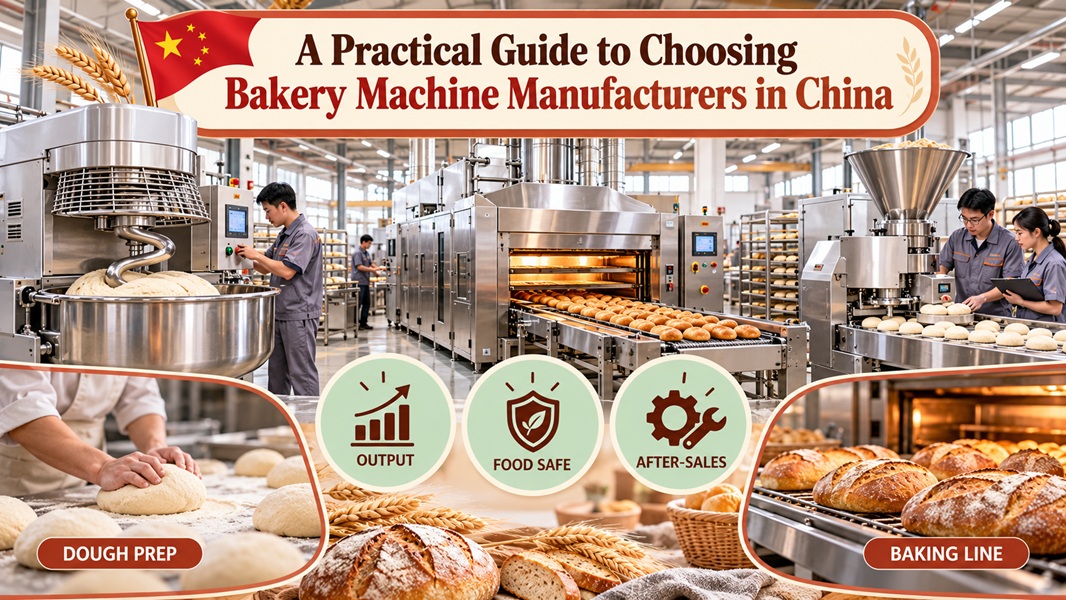
A Practical Guide to Choosing Bakery Machine Manufacturers in China
Bakery equipment should be selected around products, recipes and the pace of a real production day. A bakery making crusty loaves needs a different line from one producing cakes, flatbread or frozen dough. When comparing bakery machine manufacturers in China, map the process from mixing to cooling and packing before buying an attractive stand-alone oven or mixer. The right supplier can explain throughput, footprint, hygiene, safety and how machines work together at the target batch size.
Start with the menu and batch plan
List products, dough weights, recipe hydration, batch frequency and required units per shift. Include peak days and future products likely to be added. A planetary mixer may suit batter and small batches; a spiral mixer may be better for a particular bread dough and volume. Ask the manufacturer to size equipment against actual dough capacity, not only bowl volume. State whether dough will be divided, rounded, sheeted, proofed or deposited automatically. A useful equipment schedule follows the recipe and staff workflow, then identifies where labor or floor space limits output.
Check the bottleneck in the whole line
The fastest mixer does not increase finished output if proofers, ovens or cooling space cannot keep up. Calculate how long each stage takes and how many batches can be in process at once. Ask for a line balance showing trays or racks per hour, product pieces per tray, bake time, loading time and changeovers. For an oven, request usable chamber dimensions, rack or tray format, heat-up time and temperature recovery after loading. Compare the proposed capacity using the specific bread or pastry, not a generic “pieces per hour” number.
Evaluate baking quality in a practical trial
Send your recipe or run a close equivalent during a factory test. Check product color, internal texture, weight loss and uniformity across tray positions. For ovens, ask how temperature and airflow are controlled and whether steam is available when your product requires it. For proofers, confirm humidity range and recovery during door openings. For dough handling equipment, look for tearing, sticking and excessive flour use. Record settings and results so the local commissioning test can repeat them. A short demonstration using a different product is insufficient proof of your desired quality.
Inspect cleanability and food-contact construction
Bakery equipment accumulates flour, oil, sugar and crumbs in places that can be hard to reach. Examine guards, seals, removable trays, belts and surfaces near bearings. Ask which parts are food contact and how they are cleaned without damaging controls. The design should allow the cleaning frequency required by your products and local food rules. Where allergens are present, assess how thoroughly a machine can be cleaned between recipes and how cross-contact is controlled. Request written cleaning instructions and demonstrate disassembly during acceptance testing.
Review utilities, heat and working space
Confirm the electrical supply, connected load, gas type and pressure if applicable, exhaust needs, water connection, drainage and compressed air use. Ask for a scaled layout with door swings, rack movement and maintenance clearance. Heat from ovens affects staff comfort and nearby proofing conditions, so ventilation planning matters. Check whether the building can carry the weight of large ovens and whether equipment can pass through access doors. Include installation materials and commissioning in the quotation; an inexpensive machine can require costly site modifications.
Make safety and training part of selection
Mixers, sheeters and slicers have moving parts that require suitable guards and safe cleaning procedures. Review emergency stops, interlocks, hot-surface protection and instructions for electrical isolation. Train operators on normal use, jam clearing and changeovers, not just startup. Request manuals in a language the staff can use and clear component labels. If the bakery will depend on a single machine, obtain a starter set of critical spares and a defined support response. The practical cost of a failure is lost production during the busiest selling hours.
Plan the first months of production
Ask the manufacturer to provide a commissioning schedule with recipe setup, operator training and a trial of the most demanding product. Make a list of consumables needed from day one: belts, trays, liners, blades or filters, depending on the machines selected. Decide where finished goods cool and how they move to packing without crossing raw ingredient traffic. Record accepted settings for each product and a simple procedure for restoring them after maintenance. This preparation turns a machine delivery into a usable production process and gives the bakery a way to check whether training has worked.
Check cleaning time in the production schedule
The line plan should reserve time for cleaning between recipes and at the end of the day. Ask the supplier to demonstrate how guards, bowls, trays and belts are reached, and count the people and tools needed. If a machine takes far longer to clean than expected, the bakery may miss the next batch even when rated production speed is adequate. Include this time in the capacity calculation and in staff training. Cleanability is therefore an operating cost and a food quality concern, not simply a maintenance preference.
Compare like-for-like offers
Ask each supplier to quote the same product mix, tray size, output, utility conditions, acceptance test, spare parts and warranty. Separate optional accessories and site work from the base machine price. Clarify whether equipment is manufactured in-house or integrated from other makers and who handles issues across the line. Inspect a pre-shipment build for the correct controls, guarding, dimensions and documentation. EquipMachines lists bakery machines such as proofers, ovens, mixers and slicers. A detailed bakery brief will help it, or any competing manufacturer, recommend equipment that fits your process rather than simply offering the lowest quoted unit.
Bakery owners and food equipment distributors in South Africa, Egypt, Kenya, Ghana, Angola, Brazil, Argentina, Chile, Colombia, and Peru should send Chinese bakery machine manufacturers a production plan rather than a list of machine names alone. Include recipes, dough weights, batch frequency, tray sizes, and finished products per shift. Ask suppliers to balance mixer, proofer, oven, cooling, and packing capacity, then demonstrate the most demanding product. Compare cleaning access, utilities, installation work, training, and spare parts alongside the equipment price.
Bakery Machine Manufacturers in China FAQ
- How should I size a bakery mixer? Use actual dough weight, recipe characteristics, batch frequency, and the mixer’s stated working capacity.
- Why should I assess the whole bakery line? Proofing, baking, cooling, or packing may limit output even when a mixer has spare capacity.
- What should an oven trial demonstrate? Test your product for color, texture, consistency across trays, and recovery between loads.
- What should be included in a bakery equipment quote? Confirm utilities, accessories, installation, training, cleaning requirements, spares, and warranty terms.