
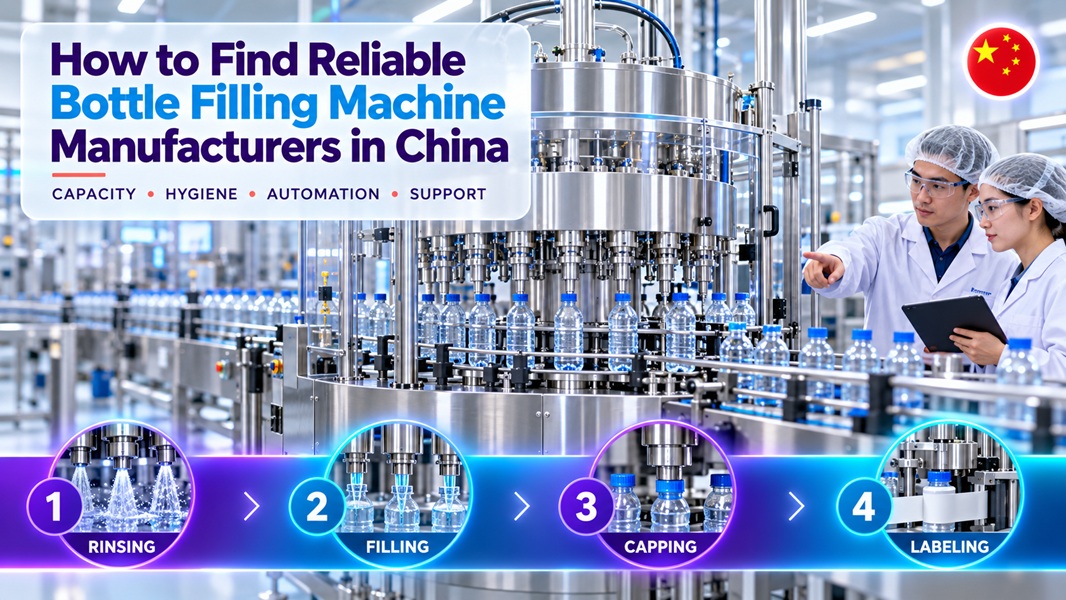
How to Find Reliable Bottle Filling Machine Manufacturers in China
Bottle filling machines serve products as different as water, edible oil, cosmetics and viscous sauces. That variety makes broad claims of “automatic bottle filling” difficult to compare. A reliable bottle filling machine manufacturer in China will ask about the liquid, container and production target before recommending a filler. Buyers should answer those questions in writing and judge suppliers on trials, cleanability, integration and service, as well as price.
Define the product and bottle precisely
Provide liquid viscosity, temperature, foam tendency, particulates and any ingredient that may affect seals or contact materials. Identify whether the product is food, cosmetic or industrial so the manufacturer can propose the appropriate construction and cleaning approach. Send drawings and physical samples of every bottle and closure. State fill range, neck finish, bottle stability and label or coding requirements. If the line must switch between 100 ml and 1 litre, for example, ask how adjustments are made and what change parts are needed. A single nominal bottle size is not enough to design a flexible line.
Select a filling principle for the job
Different liquids can call for gravity, piston, pump, weight-based or flow-based filling. Ask suppliers to explain the choice and its limits for your product, rather than accepting an unexplained machine category. Discuss drip control, foam management, bottom-up filling, recirculation and product recovery where relevant. For products that separate or settle, ask how uniformity is maintained in the supply tank and distribution manifold. For hygiene-sensitive goods, review the entire path from tank to capped bottle. A filler should be selected as part of the process, not treated as a universal module.
Specify measurable line performance
Define accepted bottles per hour at each fill volume, acceptable fill variation, cap quality and reject rate. State the test liquid, bottle, run duration and sampling method. Ask for real performance when bottles are fed, filled, capped and discharged, including normal stops. Machine head count alone does not establish output; indexing, bottle handling and downstream equipment may limit the rate. Require a demonstration using your most difficult bottle and product if possible. Record adjustment time between formats and whether tools or specialist staff are needed.
Review sanitation and product changeover
Ask for drawings of nozzles, valves, hoses, tanks and dead legs. Confirm product-contact materials and seal compatibility. Determine whether clean-in-place is supported and what portions of the line it actually covers. Where parts are removed for cleaning, inspect access and the time needed to reassemble them. For products with fragrances, colors or allergens, include a changeover test. A glossy stainless exterior is less important than a product path that can be cleaned and verified to your required standard. Have the relevant quality specialist approve the proposed cleaning method before purchase.
Check bottle handling and other machines
Even an accurate filler can underperform if bottles tip, jam or arrive unevenly. Review conveyor width, guide adjustments, bottle sensors, accumulation and rejection. Identify who supplies the rinser, capper, induction sealer, labeler, coder and inspection unit, if needed. Request a layout and control interface description so all sections stop and restart safely together. Confirm the line can handle the exact cap and neck combination. When sourcing from multiple vendors, name one integrator responsible for line-level output and fault finding.
Ask for documentation and support
The purchase package should include electrical and pneumatic drawings, operating and maintenance manuals, parts list, recipes or settings backup, and a plan for operator training. Check lead times for nozzles, seals, pumps, sensors and control components. Agree warranty scope, remote troubleshooting and on-site service conditions. Confirm electrical supply, compressed air use, water, drainage and floor space before shipping. A factory acceptance test and an installation acceptance test should use the same written criteria, with clear remedies for failures.
Check rejects and recovery
Ask what happens when a bottle is missing, fallen, incorrectly filled or uncapped. The line should stop or reject the item in a controlled way, and operators should be able to see the reason. Define whether rejected product can be recovered safely and how much remains in tanks, hoses and nozzles at the end of a batch. This matters greatly for costly liquids and short runs. Include a test of restart after a planned stop, because an accurate machine in steady operation can still spill or misfill when the conveyor starts again. Record reject counts during acceptance rather than judging only a handful of filled samples.
Include a practical operator handover
During commissioning, have operators perform a normal startup, a format change, a cleaning cycle and a controlled shutdown while the supplier observes. Record the steps in the local language and keep photos of correctly assembled change parts. This exposes difficult instructions before production starts and provides a training record for new staff. It also shows whether the machine can be maintained by the team that will actually run it.
Compare total cost and make a decision
Use a common specification for every quotation and include change parts, cleaning time, product loss, utility use, maintenance and expected downtime. Check packing, freight terms and import documents. A cheaper filler that wastes product or takes hours to change format may cost more within a few months. EquipMachines lists bottle filling machinery, including semi-automatic options. Whether you buy from EquipMachines or another supplier, send the product and packaging samples early and insist on a test that shows the machine can repeatedly produce saleable bottles at the required speed.
Beverage, food, cosmetic, and industrial product businesses in Tanzania, Ethiopia, Morocco, Algeria, Nigeria, Ecuador, Guyana, Suriname, Uruguay, and Venezuela should provide Chinese bottle filling machine manufacturers with actual liquid and packaging samples. Describe viscosity, foam, particles, fill volumes, bottle shapes, and closures. Require a timed trial that records saleable output, fill variation, changeover time, and rejected bottles. If rinsing, capping, labeling, or coding is required, identify who will integrate those machines and guarantee the performance of the complete line.
Bottle Filling Machine Manufacturers in China FAQ
- What samples should I send a filling-machine manufacturer? Send the actual liquid, bottles, caps, and details of every size or format the line must handle.
- Which filling method is best? The suitable method depends on viscosity, foam, particles, fill volume, accuracy, and cleaning requirements.
- How should filling accuracy be tested? Measure a defined sample of filled bottles during a timed run at the intended production speed.
- What happens if a bottle is missing or incorrectly filled? Ask the supplier to demonstrate the line’s stop or reject response and how operators investigate the fault.