
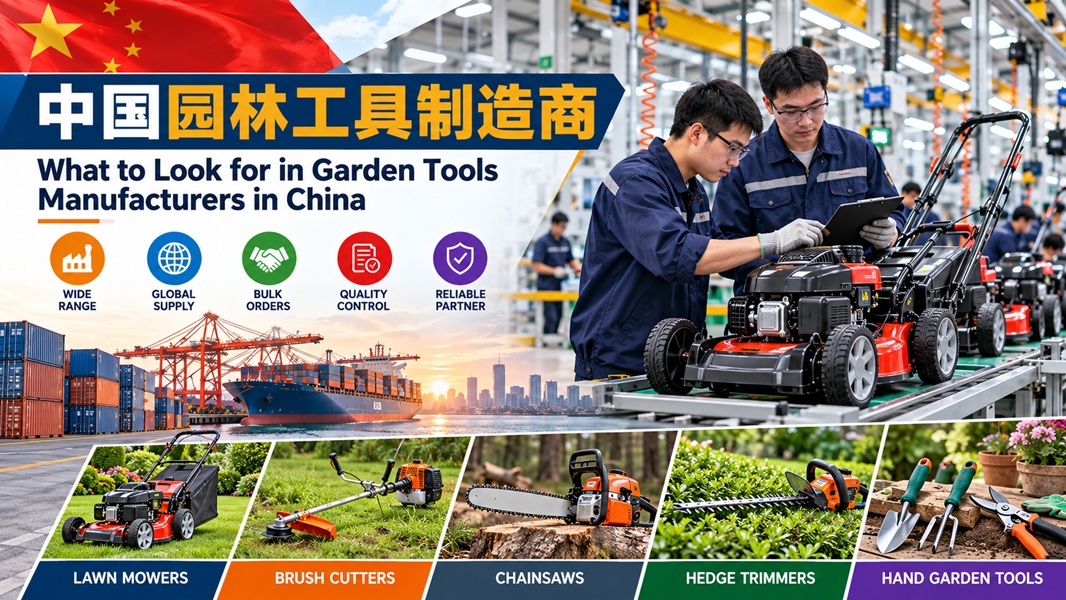
What to Look for in Garden Tools Manufacturers in China
Buying garden tools in volume calls for more than comparing catalogue photos. A pruning shear, spade, lopper and powered mower face different stresses, yet each must arrive in the promised condition and perform consistently across a batch. The right garden tools manufacturer in China will help you translate your market's needs into a testable specification, show how production is controlled, and support the order after delivery. Start with the jobs your customers actually do, then compare suppliers against the same written requirements.
Define the range before comparing factories
Make a product list with intended users, quantities and target price bands. A municipal landscaping team may need repairable, heavy use tools, while a retail chain may prioritize attractive packaging and a balanced feel. For cutting tools, define branch diameter, blade type, tool length and whether replacement blades are needed. For digging tools, state head dimensions, material, weight and handle type. Powered products require a separate sheet covering voltage or fuel type, duty cycle, operating environment and spare parts. A supplier that is strong in hand tools may source motors from another plant, so ask which items it manufactures directly and which it subcontracts.
Inspect materials and construction
Marketing phrases such as “heavy duty” are hard to verify. Ask for the steel grade or material specification, blade heat treatment, handle material, coating method and assembly details. On a pruning shear, examine blade alignment, pivot play, spring action and the lock. On a spade, inspect the socket or weld where the head joins the handle. A comfortable grip matters, but a loose or cracked connection ends the product's useful life quickly. Request a sample from the intended production design, not a showroom sample, and record its dimensions and mass so incoming goods can be checked against it.
Make testing specific to the tool
Set acceptance criteria for the work the tool must perform. A shear can be tested for clean cuts through a specified branch material and for repeated opening and closing. A shovel can be examined for head deformation and handle retention after a practical load test. Coatings can be checked for coverage, adhesion and corrosion resistance according to the environment in which the tools will be sold. Powered equipment deserves an operating demonstration and a check of guards, switches, vibration and instructions. Ask the manufacturer to propose test methods and sample sizes, then agree them before the purchase order. A test certificate is more useful when it identifies the model, batch and actual result.
Review production and quality control
Ask for a simple process map: where are heads forged or stamped, where are blades ground, when are handles fitted, and what is checked before packing? Look for incoming material inspection, in-process checks and final batch sampling. If multiple factories contribute to one order, name the company responsible for the complete shipment and for resolving defects. Photographs of a line are a starting point, but a live video inspection or independent factory audit can establish more. Request examples of corrective action when a batch fails a dimension, finish or functional test. A credible supplier should be able to explain how it prevents the same fault next time.
Check packaging for the journey and the customer
Packing influences both corrosion risk and retail presentation. Confirm whether cutting edges receive sleeves, exposed metal gets suitable protection, and cartons can withstand the planned handling. For sea shipments, ask how the supplier controls moisture and protects finishes; agree carton strength, pallet arrangement and any permitted wood packaging. If you sell under your own brand, review artwork, warnings, barcodes, country of origin marking and instruction language on a physical preproduction pack. Do not assume a printed mockup proves the final tool is identical. Inspect packed samples as well as loose tools.
Compare the full landed cost
A low unit price can hide a high rejection rate, weak cartons or a large minimum order. Request a quotation that separates tooling, branding, samples, testing, spares, packing and freight terms. Confirm the currency, quote validity, delivery point and whether mixed products can ship together. Build a comparison sheet using the same specifications and Incoterm for every bidder. Include expected freight, import charges, local delivery, warranty handling and spare parts. If a supplier proposes a cheaper material or shorter handle, treat it as a different product, not a like-for-like saving.
Set clear terms for repeat orders
Put drawings, approved samples, tolerance ranges, packaging artwork, inspection rules and delivery milestones into the purchase documents. State how nonconforming goods will be handled and who pays for rework or replacement. For seasonal products, place the order early enough to allow production, inspection and transit before peak demand. Ask whether the supplier can hold the approved specification for repeat orders and identify changes to components before making them. A buyer who records the first order well makes the second order faster and less risky.
Questions worth sending with an enquiry
Ask which models are made in-house, what material and coating options are available, which tests are routine, and what order quantity is needed for your brand. Request a sample, a batch inspection plan, carton dimensions, gross weight, lead time and a spare parts list for powered products. EquipMachines lists garden tools including shears and loppers; use a specific product brief when approaching any supplier, including EquipMachines, so its quotation can be checked against your intended use. The best manufacturer is the one that can reproduce the approved tool across the whole shipment and document how it did so.
Garden tool distributors, landscaping contractors, and institutional buyers in Nigeria, South Africa, Kenya, Ghana, Tanzania, Brazil, Colombia, Peru, Chile, and Argentina can source tools from China by starting with a clear product specification. Whether the order covers pruning shears, loppers, spades, or rakes, specify the materials, dimensions, finish, packaging, and quantities required for your customers. Request production samples and a batch inspection plan before placing a bulk order. Send EquipMachines your product list and destination port to obtain a quotation you can compare against those requirements.
Garden Tools Manufacturers in China FAQ
- What should I check in a garden tool sample? Check dimensions, blade alignment, handle attachment, finish, comfort, and performance in the intended task.
- How can I assess a manufacturer’s quality control? Ask for its inspection plan, batch test results, and the acceptance criteria used before packing.
- Can Chinese manufacturers supply private-label garden tools? Many can, but confirm minimum quantities and approve physical samples of the tool and branded packaging.
- What should a bulk quotation include? Request unit price, minimum order, materials, packaging, testing, lead time, freight terms, and defect remedies.