
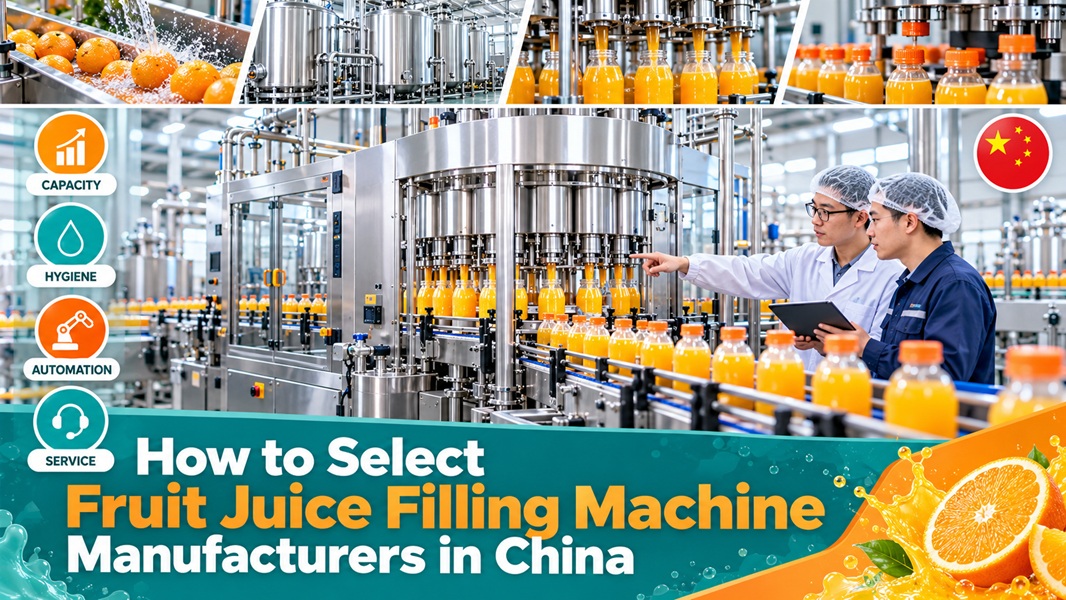
How to Select Fruit Juice Filling Machine Manufacturers in China
Fruit juice filling is a process decision as much as a machine purchase. Product acidity, pulp content, packaging and shelf-life target shape the filling method, cleaning system and upstream treatment. A machine that fills water neatly may clog on pulpy juice or prove difficult to sanitize between flavors. When selecting fruit juice filling machine manufacturers in China, describe the complete process and ask suppliers to prove performance with your product and container. That approach produces a useful comparison of output, hygiene and running cost.
Define the juice and the package
Tell each supplier whether the product is clarified, pulpy, concentrated, chilled, hot-filled or aseptically processed. Record viscosity range, particle size, filling temperature, acidity and any ingredients that foam or settle. Specify bottle or carton material, shape, neck finish, nominal fill volume, closure type and label position. Include the expected number of product and container changes per week. Ask the manufacturer to flag any combination it cannot handle. “Suitable for juice” is too broad to establish whether valves, nozzles, seals and product paths are appropriate for a specific recipe.
Match filling technology to the process
Gravity, flowmeter, piston and other filling approaches have different strengths, especially when product properties vary. Rather than choosing a method from a brochure, request a recommendation with reasons: how it controls fill quantity, treats pulp, reduces dripping and handles foaming. Ask whether the proposed line is designed for cold filling, hot filling or a validated aseptic process. Shelf life depends on the entire system, including treatment, packaging, closure and sanitation; a filler alone cannot create a safe shelf-stable product. Your food technologist should approve the process before equipment is ordered.
Specify output under real conditions
Machine speed is often quoted at ideal settings. Give the supplier a target in saleable bottles per hour, fill size, juice type, bottle dimensions and shift pattern. Ask for demonstrated output including normal stops, changeovers and cleaning. Define acceptable fill variation and reject rate, and decide how they will be measured during a timed run. If the capper or labeler is slower than the filler, that slower unit sets line output. Request a line balance showing washing or rinsing, filling, capping, inspection, coding and packing so individual machine ratings are not confused with finished-product capacity.
Review hygienic design and cleaning
Ask for product-contact material grades, surface finish where relevant, seal materials, drain points and access to valves and nozzles. The equipment should be cleanable for the intended food and process, without inaccessible pockets that retain residue. Where clean-in-place is proposed, request a flow diagram and the required cleaning flow, temperature, chemistry and time; then confirm that the whole product path is included. Where manual cleaning is necessary, check that parts can be removed safely and reassembled consistently. Ask for cleaning instructions and validation support suited to the destination's food rules. Stainless steel alone is not proof of hygienic design.
Run a product trial before acceptance
Send representative bottles, caps and enough actual juice for a meaningful test if feasible. Run the product at the intended temperature and include the most difficult variant, such as the pulpiest recipe. Measure fill weights or volumes across heads, examine foam and dripping, check cap application, and inspect for bottle damage. Document the length of the run and every stoppage. If a remote factory acceptance test is used, agree camera views and data records in advance. Keep samples or records from the trial so the final installation can be compared with the approved result.
Check utilities and integration
The quotation should state electrical voltage, phase and frequency, compressed air pressure and consumption, water quality, steam or heat requirements, drainage and floor space. Request a scaled layout with service clearances and product flow. Confirm how the filler communicates with upstream tanks and downstream equipment, including stop signals and accumulation. For a complete juice plant, discuss extraction, filtration, blending, thermal treatment and filling together; otherwise, a filler may arrive before the process supply can feed it consistently. Assign responsibility for installation, commissioning and operator training in writing.
Confirm records for quality and traceability
Ask which batch records the line can produce and how operators record cleaning, fill checks and rejected bottles. If the plant needs electronic data, specify the fields, export format and access rights before ordering. Check that labels, date codes and product changes can be linked to a production lot. A simple paper record may be enough for a small operation, but it must still support a product investigation. Decide who will set limits and review alarms at the site. This discussion also reveals whether the manufacturer understands the difference between machine automation and the buyer's wider food quality system.
Compare suppliers on service and documentation
Ask for a component list, spare parts package, drawings, electrical diagrams, operating and cleaning manuals, and software backup arrangements. Confirm who owns the control program and how changes will be handled. Check lead time for seals, valves, sensors and filling heads. Review warranty scope, remote support hours and whether an engineer can attend the site. Compare quotations on the same acceptance test, utilities and documentation, not just purchase price. EquipMachines lists juice processing and filling equipment; a detailed product and package brief will help any manufacturer propose the right configuration and expose gaps before they become expensive installation problems.
Juice producers in Nigeria, Kenya, Ethiopia, Ghana, Angola, Brazil, Colombia, Ecuador, Peru, and Suriname can compare filling machines from China more effectively when they send suppliers details of both the drink and its package. State whether the juice contains pulp, how it is processed, its filling temperature, and the bottle or carton sizes required. Ask for a trial using representative product and containers, with results for fill accuracy, output, rejects, and cleaning time. A complete quotation should also identify utility needs and responsibility for installation.
Fruit Juice Filling Machine Manufacturers in China FAQ
- Can one filling machine handle every type of juice? Not necessarily. Pulp, viscosity, foam, filling temperature, and container type can require different equipment or settings.
- What should be measured during a filling trial? Check saleable bottles per hour, fill variation, dripping, foam, cap quality, rejects, and stoppages.
- Does a juice filler determine product shelf life? No. Shelf life depends on the full process, including treatment, sanitation, packaging, and closure.
- What cleaning information should I request? Ask for product-path drawings, cleaning instructions, contact materials, and proof of which sections the cleaning system covers.