
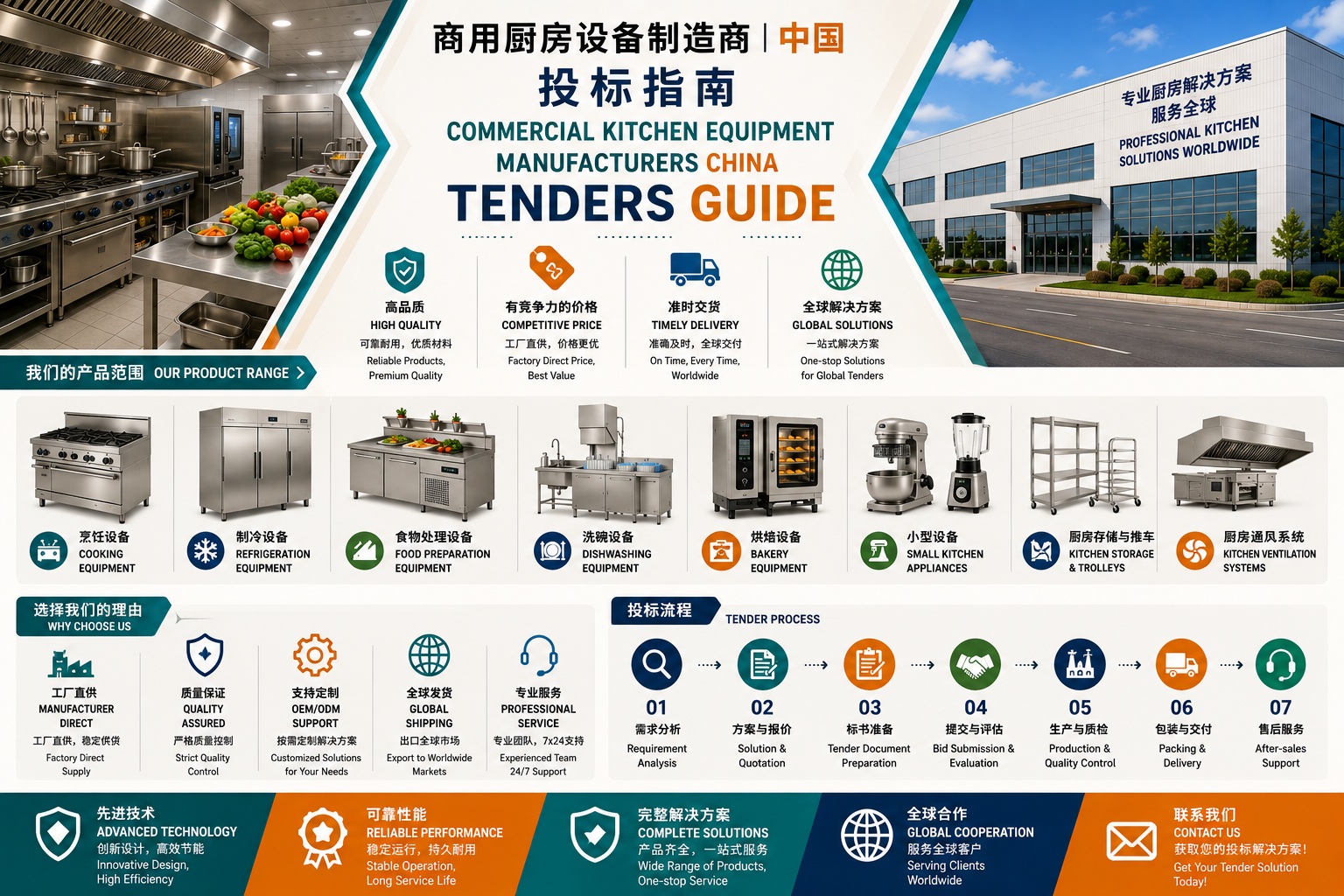
Commercial kitchen and refrigeration equipment is tendered by hospitals, hostels and residential schools, universities, defence and police messes, prisons, railway catering units, central kitchens and mid-day meal facilities, hotels under public ownership, canteens and industrial catering contractors. Orders are usually turnkey packages covering equipment supply, installation, commissioning, staff training and a maintenance contract.
China's production base for this equipment is concentrated in Guangdong, Zhejiang and Shandong, and the quality band is wide — from bare-minimum export product to equipment matching European build standards. The specification you write determines which end you receive.
Commercial kitchen equipment manufacturers in China
A typical institutional kitchen tender covers:
- Cooking: ranges, bulk cookers, tilting bratt pans, steam-jacketed kettles, deep fryers, griddles, tandoors, rice cookers, combi ovens and steamers
- Preparation: work tables, sinks, vegetable cutters, dough mixers, wet grinders, meat mincers and food processors
- Holding and service: bain maries, hot cupboards, service counters, plate warmers and trolleys
- Dishwashing: hood-type and rack conveyor machines, pot wash sinks and dish landing tables
- Ventilation: exhaust hoods, ducting, fans, grease filters and fire suppression
- Storage: shelving, racks, dry store units and cold rooms
The dominant technical clause across all of it is stainless steel grade. Tenders almost universally specify SS 304 for food-contact and structural surfaces, and SS 316 where salt or acid exposure is heavy. Chinese factories default to SS 201 unless told otherwise — it looks identical, costs materially less, and corrodes in a working kitchen within months. It will fail a material test at inspection. Get mill test certificates and verify the grade yourself.
Other clauses that decide acceptance:
- Sheet thickness, usually stated in millimetres or gauge for table tops, sink bowls and body panels
- Welded versus knock-down construction, and weld finish quality
- Gas type — LPG, PNG or dual fuel — with correct injector sizing, and burner rating in kilowatts
- Electrical supply — voltage, phase and frequency, matched to the site
- Insulation on hot equipment, and surface temperature limits
- Hygienic detailing — coved corners, no dead pockets, drainable surfaces, adjustable bullet feet
- Gas safety devices, including flame failure protection, which is mandatory in most institutional tenders
Combi ovens, dishwashers and larger cooking equipment are often specified with named European component brands for controls, pumps and valves. Confirm what the factory actually fits rather than what the catalogue claims.
Commercial refrigeration manufacturers in China
Refrigeration is where the highest failure rate occurs after installation, and where the tender specification needs to be most precise.
The scope typically covers:
- Reach-in refrigerators and freezers
- Undercounter and back-bar units
- Display counters, deli cases and cake showcases
- Blast chillers and blast freezers
- Cold rooms and walk-in freezers
- Ice machines
- Refrigerated preparation counters
Specification points:
Refrigerant. The most common disqualifier. R22 is phased out almost everywhere. R404A is being restricted under F-gas rules. Tenders increasingly mandate low-GWP refrigerants such as R290, R600a or R448A. Confirm which gas the destination country permits and which the factory can actually supply, because a compliant model is not always in their standard range.
Compressor. Named brands — Embraco, Danfoss, Tecumseh, Copeland — appear in many tenders. Chinese compressors are acceptable in some, but the brand must be declared in the bid.
Temperature range and recovery. Specify operating range, ambient class the unit must hold that range in (climate class 4 or 5 matters in hot regions), and pull-down time for blast equipment.
Insulation. Panel thickness and foam density for cold rooms, and the blowing agent used.
Energy consumption. Increasingly a scored evaluation criterion rather than a pass-fail clause. Ask for kWh per 24 hours at a stated ambient.
Construction. Interior and exterior material grade, door gaskets, self-closing doors, digital controllers and defrost method.
For cold rooms, also confirm floor construction and load rating, door type, safety release from inside, and whether the condensing unit is indoor or outdoor rated.
Turnkey scope: the part that gets underestimated
Kitchen tenders are rarely supply-only. Expect these in scope:
- Site survey and layout drawing approval before manufacture
- Civil, electrical, gas, water and drainage requirement drawings issued to the buyer
- Delivery, positioning and installation
- Ventilation ducting fabrication and installation, often the largest hidden cost
- Commissioning and performance demonstration
- Staff training on operation and daily cleaning
- One to three years of comprehensive maintenance
Ventilation is the item most commonly underquoted. Ducting is usually fabricated locally rather than imported, so get a local fabrication quote before finalising your bid price.
Tender documentation checklist
- Manufacturer's Authorisation Form naming the tender number
- Mill test certificates for all stainless steel grades
- CE marking with the applicable directives, and gas appliance certification where required
- ISO 9001 for the manufacturing unit
- Refrigerant compliance declaration and energy consumption data
- Compressor and major component brand list
- Electrical schematics and gas piping drawings
- Layout drawings with utility loads for buyer approval
- Installation, commissioning and training plan
- Spare parts list with prices and availability undertaking
- Service engineer availability in the buyer's region
- Past supply performance certificates for comparable institutional kitchens
Lead times and installation planning
Fabricated stainless items run 35–55 days. Refrigeration runs 45–70 days. Combi ovens and dishwashers run 50–75 days. Full turnkey kitchens run 90–120 days including drawing approval cycles, which regularly consume three to four weeks on their own.
Order the drawing approval process first. Kitchen tenders slip because manufacturing cannot start until the buyer signs off the layout, and that sign-off tends to sit with a committee. Build that delay into your delivery schedule rather than discovering it after the purchase order.
Construction Material Machinery equipmachines.com
Want the real output figure, not the catalogue one?
Send us your target production, block sizes and raw material mix, and we'll quote machines with witnessed trial capacity rather than theoretical ratings. Mould lists, foundation drawings and commissioning support included.
Discuss your plant requirement at sales@equipmachines.com